![[DEV] SC Policy Council](https://assets.nationbuilder.com/themes/64a70761f9279500cd767ee8/attachments/original/1680182376/logo-nerve.jpeg?1680182376)


By RICK BRUNDRETT
Editor’s note: This story is part of a two-article package published today. The other story can be found here.
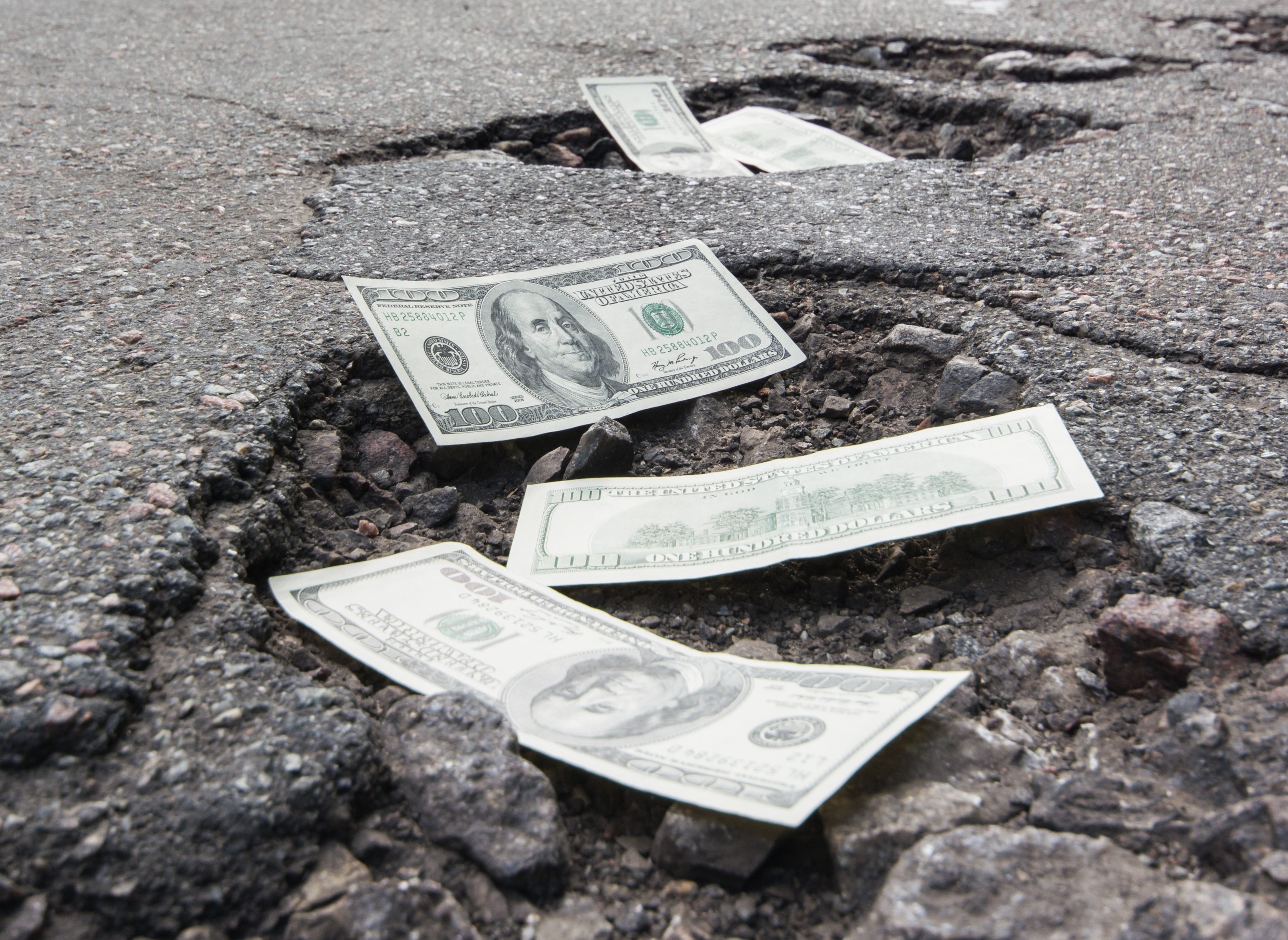
Since 2020, more than 11,500 pothole damage or injury claims have been filed against the S.C. Department of Transportation, though less than half were approved and resulted in settlements, a review by The Nerve found.
From Jan. 3, 2020, through July 25 of this year, 11,588 pothole claims totaling $43.5 million were filed, records show. Of the total claims, 5,112, or 44%, were approved with a collective $4.7 million in settlements.
The listed payouts ranged from 1 cent to $295,000; 4,195 settlements, or 82% of the total, were less than $1,000, The Nerve’s review found. The average payout was $921; the median settlement, or midway point of all approved claims, was $406.
State law caps settlements against government agencies at $300,000 for one claimant and a collective $600,000 for multiple claims arising from a single occurrence – ceilings that have remained in effect for nearly 30 years.
An amended tort-reform bill that the Senate passed this year would significantly increase the caps, though the bill’s main sponsor, who is the Senate’s majority leader, didn’t propose it when the bill was introduced.
In July, The Nerve requested, under the S.C. Freedom of Information Act, records of all road claims filed against DOT going back to 2020. The agency in mid-September released more than 600 pages of records, most of which were pothole claims, though it redacted names and any other identifying information, citing state privacy laws.
In analyzing pothole claims, The Nerve matched some larger settlements with available online state Insurance Reserve Fund (IRF) records for the period.
The IRF, which provides liability and property insurance for participating state and local government agencies, is a division of the State Fiscal Accountability Authority. The authority is overseen by a five-member board that is chaired by the governor.
In a written response to The Nerve when the road-claim records were released, DOT said claims of $2,500 or more made after Oct. 24, 2024, are forwarded to the IRF; before that date, claims of less than $1,500 were handled by DOT, while claims over that amount were sent to the IRF.
In a companion story published today, The Nerve interviewed a motorcyclist who said he was seriously injured after hitting a pothole on Interstate 85 in Anderson County in 2022. He received a $275,000 settlement through the IRF – the third-largest payout during the period resulting from a pothole claim, The Nerve found in its review of DOT records.
The Nerve sent a follow-up list of written questions to DOT about the provided claim records, requesting, among other things, the specific criteria that the agency uses to approve or deny claims. No response was provided.
Since state lawmakers in 2017 approved increasing the state’s base gasoline tax by 12 cents, or 75%, over six years, The Nerve repeatedly has pointed out the slow pace of repairs to the state’s crumbling roads and bridges while a special fund created with the tax hike has accumulated huge reserves.
In an analysis published Oct. 3, the South Carolina Policy Council – the parent organization of The Nerve – revealed, citing federal statistics, that road quality statewide trended downward from 2013 to 2023, while spending by the state DOT and County Transportation Committees (CTCs) increased dramatically, far outpacing inflation.
The Policy Council recommended that proposals in a 2016 audit by the state Legislature Audit Council (LAC) – the Legislature’s investigative arm – be implemented. Among other findings, the LAC said DOT was not prioritizing repair projects on a worst-first basis.
In May this year, S.C. House Speaker Murrell Smith, R-Sumter, announced the formation of the “SCDOT Modernization Committee,” co-chaired by Reps. Shannon Erickson, R-Beaufort, and Heather Crawford, R-Horry, and “tasked to study the modernization of the South Carolina Department of Transportation,” according to a release from Smith’s office.
The ad-hoc committee was instructed to hold public hearing statewide to “hear directly from citizens about their experiences with South Carolina’s roads and bridges,” the release said, noting, “This feedback will drive policy recommendations to bring real reform and real results.”
‘Like a big depression’
Following is a breakdown by year from January 2020 through this July of the total number of filed pothole claims statewide, the total number of approved settlements, and the collective sum of approved payouts, based on DOT records provided to The Nerve:
|
Year |
# Filed Claims |
# Settlements |
Settlement Sums |
|
2020 |
1,909 |
1,055 |
$597,659.52 |
|
2021 |
2,006 |
981 |
$490,081.43 |
|
2022 |
1,984 |
772 |
$925,016.49 |
|
2023 |
2,444 |
1,228 |
$1,442,038.31 |
|
2024 |
2,099 |
745 |
$1,022,008.02 |
|
2025* |
1,146 |
331 |
$233,676.97 |
|
Total |
11,588 |
5,112 |
$4,710,480.74 |
*through July
Of the approximately 6,500 pothole complaints showing no settlements, about 4,500, or nearly 70%, were listed under the categories of “denied” or “denied – lack of jurisdiction,” The Nerve’s review found. A $20 million pothole claim out of York County was denied in 2023 – nearly half of the total amount of all claims filed during the period – though no other details about that claim were provided in DOT records.
The $4.7 million in approved settlements covered claims totaling $9.4 million, The Nerve's review found. Another 1,189 pothole complaints filed since 2020 – 10% of the total filings – were labeled as “approved,” though DOT didn’t explain why there were no recorded payouts in those cases.
“The descriptions are as-is,” the agency said in a written response to The Nerve’s request for specific definitions of all terms contained in the “status” and “cause” categories in the provided records. “There are no further details in our system.”
Not surprisingly, most of the pothole complaints during the period came from the state’s largest counties: Richland (1,559), Lexington (1,341), Charleston (842), Spartanburg (685), Greenville (676), York (594), Anderson (523), Dorchester (463), Berkeley (375), Aiken (353).
The top-two pothole settlements – $295,000 and $290,000 – in The Nerve’s review resulted from pothole incidents in Charleston and Richland counties, respectively.
But serious pothole cases have occurred in smaller counties as well.
For example, Insurance Reserve Fund records show that a total of $250,000 was paid in 2023 following three 2020 lawsuits filed against DOT that stemmed from a 2018 traffic accident in Cherokee County.
An older teenager was driving a pickup truck, with his brother and another relative, both of whom were younger teens, riding as passengers, on Brick House Road near Gaffney when the truck hit a pothole, ran off the road and struck a tree, severely injuring the driver’s brother, according to one of his attorneys and court records.
The brother’s injuries included “traumatic” brain injury; fractures to his pelvis, ribs and back; and respiratory failure, which resulted in medical expenses at the time totaling $406,545.06, according to an amended petition filed by the minor’s guardian ad litem for approval of a $75,000 settlement with the insurance company for the truck’s owner.
In a recent interview with The Nerve, Ridgeland lawyer Neil Alger of the Parker Law Group, who was one of the plaintiffs’ attorneys, said his clients were returning from a fast-food restaurant and were heading on a downhill slope on the rural road when the vehicle went out of control after “interacting with basically a low spot in the road.”
“We categorized it as a pothole,” Alger said. “If you look at the pictures, it’s an area where they had patched over, over and over; and as a result, it was … like a big depression that was probably large enough to fit half a person in it.”
The driver’s brother, who was a front-seat passenger, was hit by the tree, which was forced through the truck’s cabin upon impact, he said.
Asked whether the $300,000 settlement cap under state law was sufficient to cover the boy’s injuries, Alger replied: “Ultimately, the claims that interact with the Tort Claims Act are the ones that are of the greatest value but also the greatest need – anytime you have somebody whose life is turned upside down. Three hundred thousand … it’s just a drop in the bucket.”
When dealing with potentially large settlements, IRF adjusters typically “negotiate off of” $300,000, Alger said, noting, “They say, ‘If you want 300, go to trial and get it; otherwise, we want a discount for the resources you’re not going to have to expend and the timeliness that we could resolve this in advance.’”
Alger said it’s been experience that the state will only approve a $600,000 settlement – the maximum collective amount under state law for multiple claims arising from a single occurrence – if there were significant injuries and death that occurred in a crash.
As an example, Alger said he handled a case in Chester County involving an ambulance driver who wasn’t “paying attention,” crossed a center line and hit a minivan occupied by a family. The impact killed the van’s driver and caused “lifelong” injuries to the mother, plus injured children who were passengers, he said.
‘Numerous complaints’
DOT’s neglect of potholes and other bad road conditions for months – sometimes years – can result in serious injuries, plaintiffs’ attorneys contend.
In July 2020, a motorcyclist turned onto the northbound Interstate 95 on-ramp from S.C. 9 in Dillon County, hit a deep pothole and lost control, causing him to be thrown off his motorcycle, according to court records.
“Defendant SCDOT received numerous complaints regarding subject pothole and the defective condition of the I-95 onramp in the years and months prior to the incident, and had actual and constructive knowledge of the defective and unreasonably dangerous condition of the I-95 northbound onramp, and failed to make necessary and effective repairs to the I-95 onramp, which would have the prevented the incident and resulting permanent injuries suffered by Plaintiff,” the motorcyclist alleged in a 2021 lawsuit.
In its formal response, DOT said, among other things, that if “there was any negligent, careless, reckless, willful, wanton, or grossly negligent, act or omission, which is expressly denied, any injuries or damages allegedly sustained by the Plaintiff, which are also denied, were due to and caused by the Plaintiff’s own, or one or more other person’s acts of negligence, carelessness, recklessness, willfulness, wantonness, or gross negligence.”
Insurance Reserve Fund records show that the case settled in 2023 for a total of $200,000.
In a recent interview, North Charleston attorney Milt Stratos of the Joye Law Firm Injury Lawyers, who represented the approximately 50-year-old motorcyclist, told The Nerve that a DOT employee said under oath during a deposition that he regularly took the same route on his personal motorcycle and knew that the pothole had “existed for a really long time.”
Asked if the employee ever notified other DOT workers about fixing the pothole before his client was injured, Stratos replied, “They definitely did not in that case.”
Stratos said his client suffered a “severely fractured ankle” that will have “lifelong symptoms associated with it … similar to drop-foot symptoms.”
Stratos described the current statutory settlement caps of $300,000 and $600,000 as “pretty despicable,” noting that IRF adjusters will “take the position even if there is incredibly clear liability and severe damages, like a death, that they’re basically only going to pay 250 ($250,000).”
Given the caps, Stratos said it’s typically better for clients to accept six-figure settlements somewhat below the cap than to go to trial mainly because of the high costs of hiring various experts, adding that most plaintiffs’ lawyers charge higher legal fees than the standard one-third of a settlement if a case goes to trial.
Stratos said he would support legislative efforts to “dramatically increase the caps.”
“The Tort Claims Act puts us in the position to make it nearly impossible to actually fairly, justly compensate someone,” he said.
Senator: Higher caps, higher taxpayer costs
But S.C. Senate Majority Leader Shane Massey, R-Edgefield, believes the current caps should remain in place unless changes can be made to other tort laws which would result in a greater net benefit “to taxpayers, to members of the public.”
“This is one of the more difficult balancing acts that we have to deal with,” he said in a recent interview with The Nerve. “You’ve got to figure out where to draw the line.”
Massey is the main sponsor of a tort-reform bill (S.244), which, as amended, would increase the caps by two-thirds, up from $300,000 for one claimant and a collective $600,000 for all claims arising out of a single occurrence to $500,000 and $1 million, respectively. The bill also would raise the single-occurrence cap by the same percentage, from $1.2 million to $2 million, for claims made against doctors or dentists employed by government agencies.
Massey said, however, the provision to increase the caps wasn’t included in his original bill version but later was added “as a trade-off in order get some of the other stuff that we thought were important.”
“I’m really not a big fan of raising the caps,” he said, noting that increasing the caps “has been something that the plaintiffs' lawyers have been pushing for years.”
Massey said he primarily does civil litigation and some wills and estate work. He sits on the board of the South Carolina Defense Trial Attorneys’ Association.
Lawmakers in 1986 originally established caps of $250,000 for one claimant and a collective $500,000 for all claims stemming from a single occurrence, which remained in effect until 1997 when the current caps were set. Adjusted for yearly inflation from July 1997, those caps would be approximately $603,828 and $1.2 million, respectively, this year.
The amended S.244 passed the Senate in March this year but didn’t get out of the House Judiciary Committee. Massey’s original version dealt mainly with reforming liquor-liability laws; changes to those laws were later added to an unrelated House bill (H.3430), which the Legislature passed and was signed into law in May by Gov. Henry McMaster.
The South Carolina Policy Council – The Nerve’s parent organization – advocated for liquor-liability reforms.
Massey said he believes that if “people are injured by the government, you want them to be compensated for their loss.” He added, though, that “government gets its money from people, from taxpayers; and so if you allow for an unlimited recovery, that’s going to negatively affect taxpayers.”
Raising the settlement caps likely would increase insurance premiums for state, county and local government agencies, plus school districts, that participate in the Insurance Reserve Fund; or agencies that use other insurers, Massey said.
He believes that local agencies would be forced to raise property taxes – their main revenue source – to cover increased insurance costs, contending that higher caps also would impact local charitable organizations and hospitals.
“You’ve got to have a cap,” Massey said. “Otherwise, that means the taxpayers are on the hook for unlimited liability.”
“Wherever you set the cap, it’s going to be inadequate for somebody,” he added.
To file a damage claim against SCDOT, a claimant must complete a damage claim form provided by the agency, which has to be notarized and submitted, with supporting documents, no later than one year after the incident. In pothole cases, the form says claimants should take a picture of the pothole in question “only if you can safely do so.”
Nerve interns Jasmine Creech, Laura Anne Kay and Abagael Strating contributed to this story. Brundrett is the news editor of The Nerve (www.thenerve.org). Contact him at 803-394-8273 or [email protected]. Follow The Nerve on Facebook, Instagram and X (formerlyTwitter) @thenervesc.
Nerve stories are free to reprint and repost with permission by and credit to The Nerve.