![[DEV] SC Policy Council](https://assets.nationbuilder.com/themes/64a70761f9279500cd767ee8/attachments/original/1680182376/logo-nerve.jpeg?1680182376)


By RICK BRUNDRETT
Editor’s note: This story is part of a two-article package published today. The other story can be found here.
Chris Ellis says when he was racing dirt bikes as a kid, his biggest fears were hitting “a deer, grass in the road, or another vehicle.”
“Never in a million years I would have thought a pothole,” the 39-year-old Anderson man, who owns Ellis Heating and Air Professionals LLC, said in a recent interview with The Nerve.
But on June 30, 2022, a pothole would change his life.
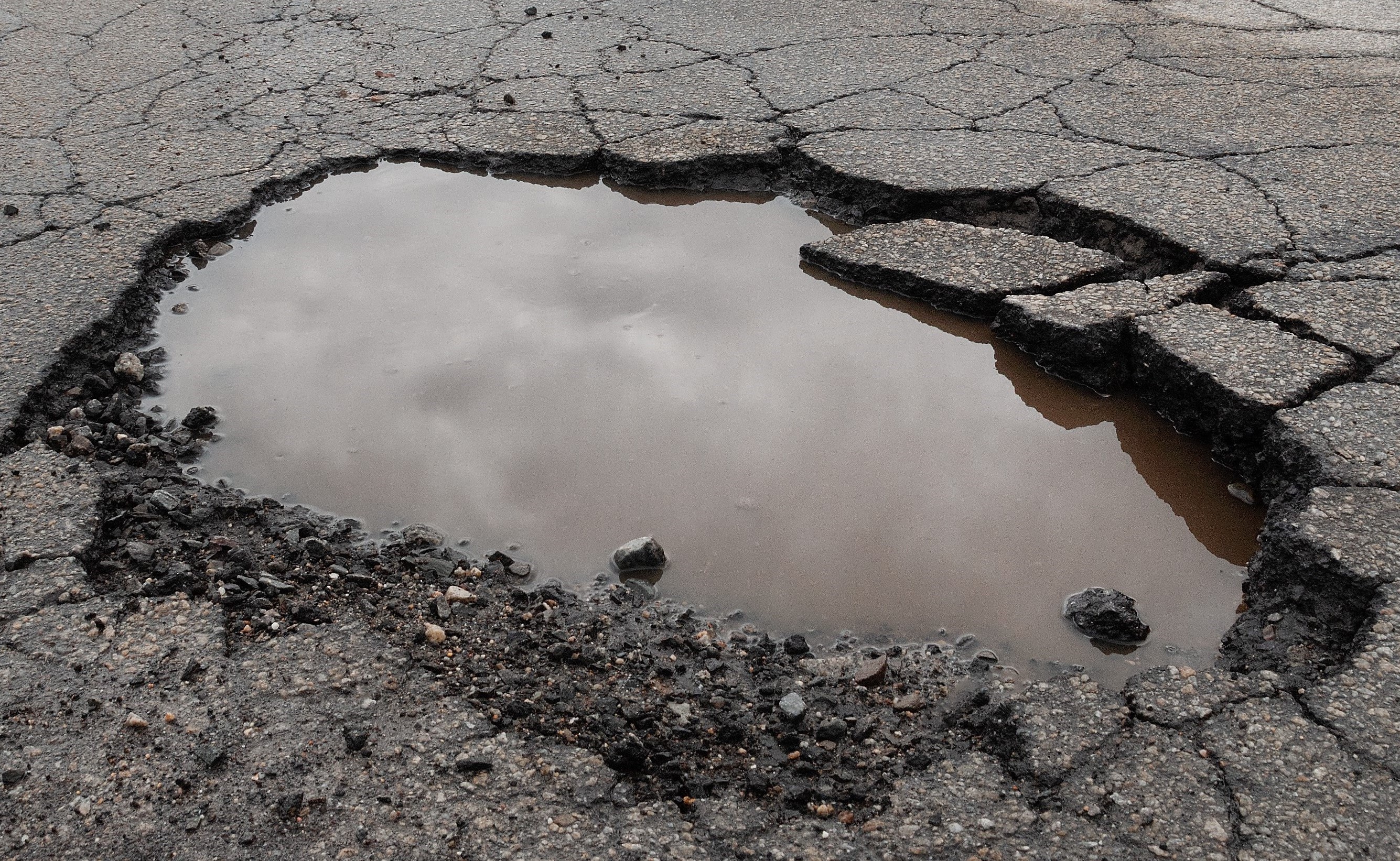
Ellis said he had checked on his camper in Fair Play near the Georgia state line and was returning home early that evening on his Harley-Davidson motorcycle on Interstate 85 in the Lake Hartwell area when he hit a pothole on the bridge at Exit 14 (S.C. 187) in Anderson County, causing him to lose control of his bike and crash.
Ellis said he doesn’t remember anything about the crash.
“They said it was pretty deep – deep enough pothole to bend my rims and tires on the front and back,” he recalled. “I was told it was 2 feet deep.”
“The front tire hits this hole that you literally can see the lake through, and, of course, it immediately stops (the motorcycle) and throws him over the bike into the guardrail,” his attorney, Daniel Draisen of The Injury Law Firm in Anderson, said when contacted by The Nerve.
The crash occurred at 7 p.m. in clear weather, Draisen said, citing a state Highway Patrol report. Ellis said he believes he didn’t see the pothole, adding he likely was following several cars that drove over the pothole.
“It’s really a miracle he didn’t die – somebody didn’t run him over,” Draisen said. “The highway patrolman said it was so bad that he parked his patrol car in front of the hole on the road with his lights on and would not move his car until DOT came out to do something with the hole.”
Ellis said he was airlifted from the scene to a hospital in Greenville. He said he spent about 10 days in a coma and approximately another month in rehab to learn how to “walk, eat – do everything – again.”
“When I saw him, I didn’t think he was going to make it,” Draisen recalled. “And he’s very blessed. I mean, I think he had an angel on his shoulder.”
Draisen said his client’s medical bills at the time totaled $320,000. Ellis credited his mother with getting his motorcycle insured several weeks before the crash, which he said largely covered his medical costs.
“I’ve always been against insurance because I never get sick,” Ellis said, jokingly adding, “If I get a cut on my finger, I wrap it up in duct tape.”
“Well, my Mom – she’s like super Mom of the year every day,” he continued. “She said, ‘Son, I’m gonna get you insurance whether you like it or not.’ ... So, she just got me insurance a couple of weeks before my wreck, and that’s a blessing right there.”
DOT records reviewed by The Nerve show a $3 million claim was filed on Ellis' behalf against DOT in October 2022 and later settled for $275,000.
In a companion story published today, The Nerve revealed that since 2020, more than 11,500 pothole damage or injury claims were filed statewide against DOT, though less than half resulted in approved settlements. Ellis’ $275,000 settlement was the third largest payout in The Nerve’s review.
Under the S.C. Tort Claims Act, settlements involving state and local government agencies are capped at $300,000 for a single claimant and a collective $600,000 for multiple claims arising from a single occurrence.
Ellis’ case was settled without a lawsuit being filed, according to records with the state Insurance Reserve Fund (IRF), which provides liability and property insurance for participating state and local government agencies.
“With the documentation the Highway Patrol did and the photographs the Highway Patrol officer took … I think they (IRF adjusters) realized this was kind of any easy one for me in terms of, ‘Why would you make me jump through the hoops?’” Draisen said.
But Draisen also pointed out that the current $300,000 cap wouldn’t have been enough by itself to cover Ellis’ total medical bills. He added that part of the settlement had to be used under state “subrogation” laws to repay some of Ellis’ private insurance coverage.
“At least he could get something out of the deal, but there wasn’t enough,” Draisen said.
Asked whether the I-85 pothole was fixed immediately after the crash, Draisen replied: “When I saw it, there was an asphalt patch of some kind over it. … My belief is that they (DOT) brought out just whatever the minimum was necessary – a dump truck with some asphalt in it – and whatever they needed to do just to put enough in to get that thing patched up pretty quickly.”
Ellis said at the time of the crash, he was working as a heating-and-air-conditioning subcontractor. Afterward, the lifelong Anderson resident said he decided to fulfill his dream of starting his own business.
“I was thinking, ‘Since I had a dramatic life change, I might as well start my own business,'” he recalled. “I was always scared to start my own company. But you know what? After my near-death accident, I said, ‘I can just go and be scared doing it.’”
“So I just took a chance and did it,” he continued. “It’s coming out great for me so far.”
Asked whether he still rides a motorcycle, Ellis quickly replied: “Absolutely not. I’ve got three daughters, and they will pitch a fit if I even talk about motorcycles.”
As for the condition of local roads and bridges he drives on these days, Ellis said, “I’m not seeing any improvements; some are getting worse and worse.”
That includes the bridge where his crash occurred.
“I still go across the bridge all the time … and that bridge is still awful,” Ellis said.
Brundrett is the news editor of The Nerve (www.thenerve.org). Contact him at 803-394-8273 or [email protected]. Follow The Nerve on Facebook, Instagram and X (formerlyTwitter) @thenervesc.
Nerve stories are free to reprint and repost with permission by and credit to The Nerve.